A public criminal or traffic record search in San Diego County begins with the type of information you need. A county court index can help locate a case number, filing date, court location, and parties. A custody system can show selected information about a person currently held in a county facility. Neither source is a complete California criminal-history report.
For a copy of your own statewide criminal-history summary, use the California Department of Justice Record Review process. The DOJ does not provide members of the public with another person's statewide criminal-history summary. For a broader explanation, see our California criminal and traffic records guide.
Start Here: Enter Any Name To View Records
Start with the source that matches your question
| Question | Starting point | What it may show |
|---|---|---|
| Was a criminal case filed in San Diego County? | San Diego Superior Court Online Case Search | Case-number, party, filing, and location information, subject to the court's access rules. |
| Is someone currently in county custody? | San Diego County Sheriff Who's in Jail | The Sheriff directs the public to search Who's in Jail by last name. The result can provide current custody information, pending charges, and the next court date when available. |
| Do I need my own California criminal-history summary? | California DOJ Record Review | A fingerprint-based copy of your own state summary, not a public search of another person. |
Search San Diego County Superior Court records
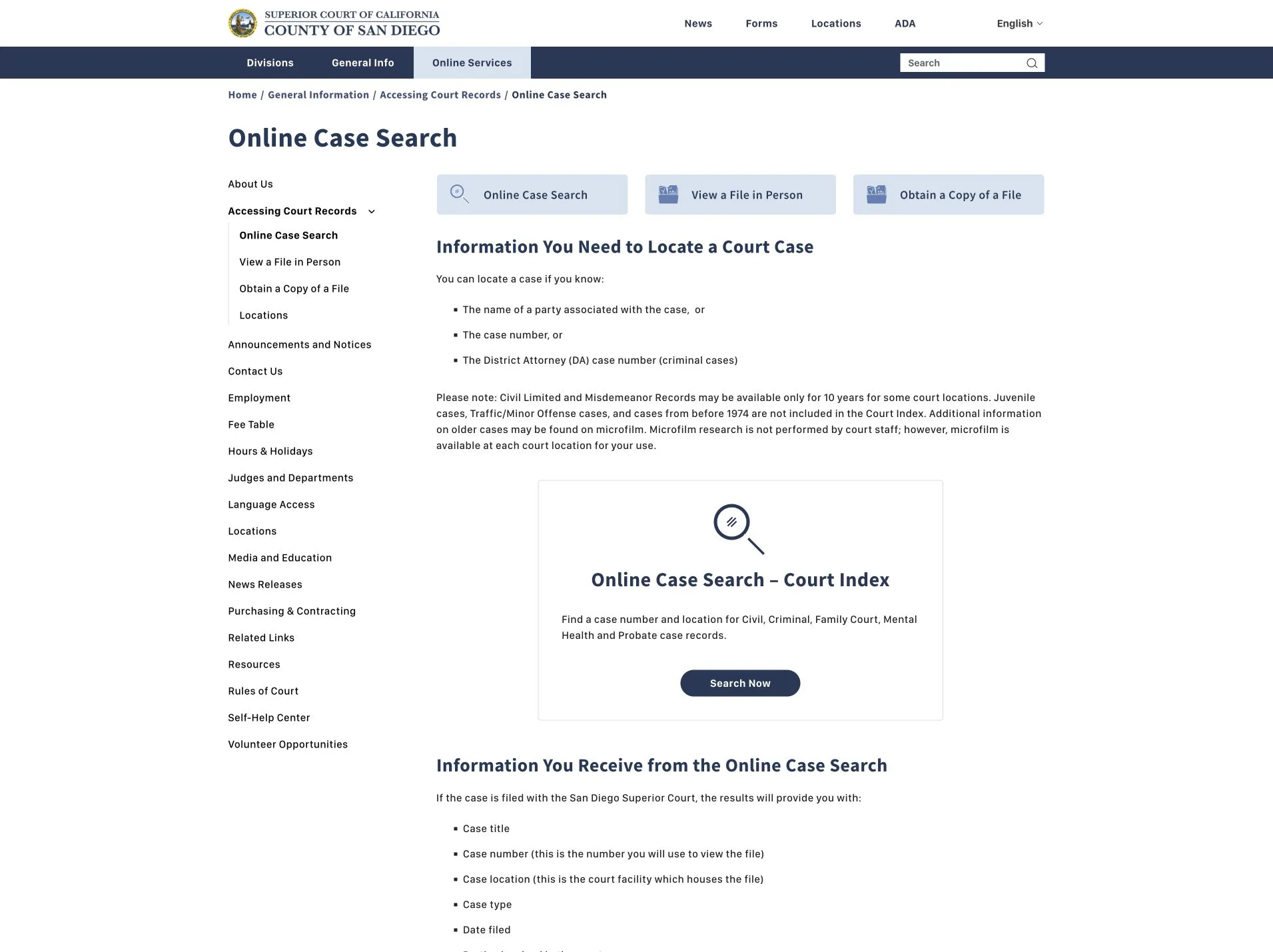
San Diego Superior Court Online Case Search is the source for criminal case records filed in this county. The court index accepts a party name, case number, or District Attorney case number for criminal cases. A result can provide the case title, number, location, type, filing date, and parties.
The court says juvenile, traffic and minor-offense cases, and cases before 1974 are not included in the online index. Criminal documents must generally be viewed at the courthouse where the matter was heard or requested by mail. A case index can confirm that a case exists, but it should not be treated as a complete history for a person. Sealed, confidential, juvenile, and other restricted records are not available simply because a name is known.
Check current county custody separately
San Diego County Sheriff Who's in Jail is separate from the court system. The Sheriff directs the public to search Who's in Jail by last name. The result can provide current custody information, pending charges, and the next court date when available. A custody result does not establish the final outcome of a criminal case. Conversely, a court case can exist even when the person is not currently in a county facility.
A city police department and the Sheriff may hold different records. Use the agency that made the arrest or created the report for a police-record request, and use the Superior Court for the related case file.
Request copies and older records
If an online index identifies a case number, use the court's records instructions to request copies or confirm where the file is held. Court access varies by case type and age. Some courts provide only an index online, while others require an in-person visit or a written copy request for criminal documents.
For an arrest or police incident report, contact the agency that created the record. A county sheriff, city police department, and Superior Court maintain different records.
What to keep in mind in San Diego County
San Diego Superior Court uses several court locations, but the court index returns the location associated with a matching case. Use that result to identify the courthouse for an in-person review or copy request.
- A court index, a jail lookup, and a DOJ Record Review answer different questions.
- An arrest does not establish that charges were filed or that a conviction resulted.
- A clean online result does not establish that no record exists. Online coverage and public access vary.
- Do not use these sources for employment, housing, insurance, credit, or another FCRA-regulated decision.
Frequently asked questions
Can I search San Diego County criminal cases by name?
Use San Diego Superior Court Online Case Search's current online access instructions. The court index accepts a party name, case number, or District Attorney case number for criminal cases. A result can provide the case title, number, location, type, filing date, and parties. Search results and access rules vary by case type and may not include every historical or restricted matter.
Does a county court search show every California criminal record?
No. A Superior Court search covers cases filed in that court. California has separate county courts, and the DOJ's statewide criminal-history summary is not a public search of another person.
Can I search county jail custody online?
Use San Diego County Sheriff Who's in Jail for its current custody-access rules. The Sheriff directs the public to search Who's in Jail by last name. The result can provide current custody information, pending charges, and the next court date when available. This information is separate from court case records.
How do I get copies of a criminal case file?
Start with the case number and contact the court that maintains the file. The court can explain whether records are available online, in person, or by mail, along with current fees and restrictions.
Are criminal court records always public?
No. California court access is limited for sealed, confidential, juvenile, and other restricted records. Remote online access can also be narrower than access available through a courthouse clerk.
Can I get another person's California DOJ criminal-history summary?
No. The DOJ Record Review process is for an individual to request their own criminal-history summary. Public court records follow separate county court access rules.
Can I use these searches for jobs, housing, or insurance decisions?
No. The services discussed on this page are not consumer reporting agencies and the information here is not a consumer report. They should not be used for employment, tenant screening, insurance underwriting, credit, or any other purpose regulated by the Fair Credit Reporting Act.