A California criminal-record search begins with the reason for the search. The California Department of Justice lets an individual request a copy of their own state criminal-history summary, but it does not process third-party requests from members of the public. If you are looking for another person's public court case, the relevant county Superior Court is usually the correct source. If the question is current state-prison custody, use the California Department of Corrections and Rehabilitation's CIRIS system.
These systems answer different questions and do not combine into one public statewide name search. A result from one source should not be treated as proof that no record exists in another. This guide explains the differences and provides a practical order for checking them.
California criminal-record quick facts
County courts
58 Superior Courts
DOJ Record Review
$25 state fee
State-prison lookup
CDCR CIRIS
Registry updates
Updated daily
These facts describe separate official systems, not one combined database. The $25 amount is the California DOJ processing fee for an individual's own Record Review and does not include a Live Scan provider's rolling fee. The daily update schedule refers to the statistics published by the California Megan's Law website.
On this page
- Choose the correct California source
- Request your own DOJ criminal history
- Search county Superior Court cases
- San Diego court-index example
- Los Angeles criminal case access
- Check California state-prison custody
- Search the California Megan's Law registry
- Understand access and record relief
- Browse county and major-city guides
- Understand important limitations
Choose the correct California criminal-record source
| Your question | Starting source | What it can tell you |
|---|---|---|
| What appears in my own California criminal history? | California DOJ Record Review | A fingerprint-based copy of your own state criminal-history summary. |
| Was a public criminal case filed in a known county? | The county Superior Court | Availability varies, but an index may show a case number, filing date, case type, parties, and courthouse. |
| Is someone currently in a California state prison? | CDCR CIRIS | Selected custody information, including facility and commitment county when available. |
| Is someone currently in a county jail? | The county sheriff or local detention agency | Current booking and custody fields vary by county. |
| Does the state publish information about a registered sex offender? | California Megan's Law website | Public information about specified registrants, subject to statutory disclosure limits and use restrictions. |
| I do not know the county. | Identity and address clues first | A prior city, address, or relative can identify which county court or sheriff system to check. |
Start a California Public Records Search
California criminal records by source
The search form above does not query California government systems or create a criminal-history report on this site. It prepares the information for an optional search with an independent commercial provider. Official verification still comes from the agency or court that maintains the underlying record.
Requesting your own California criminal history through DOJ
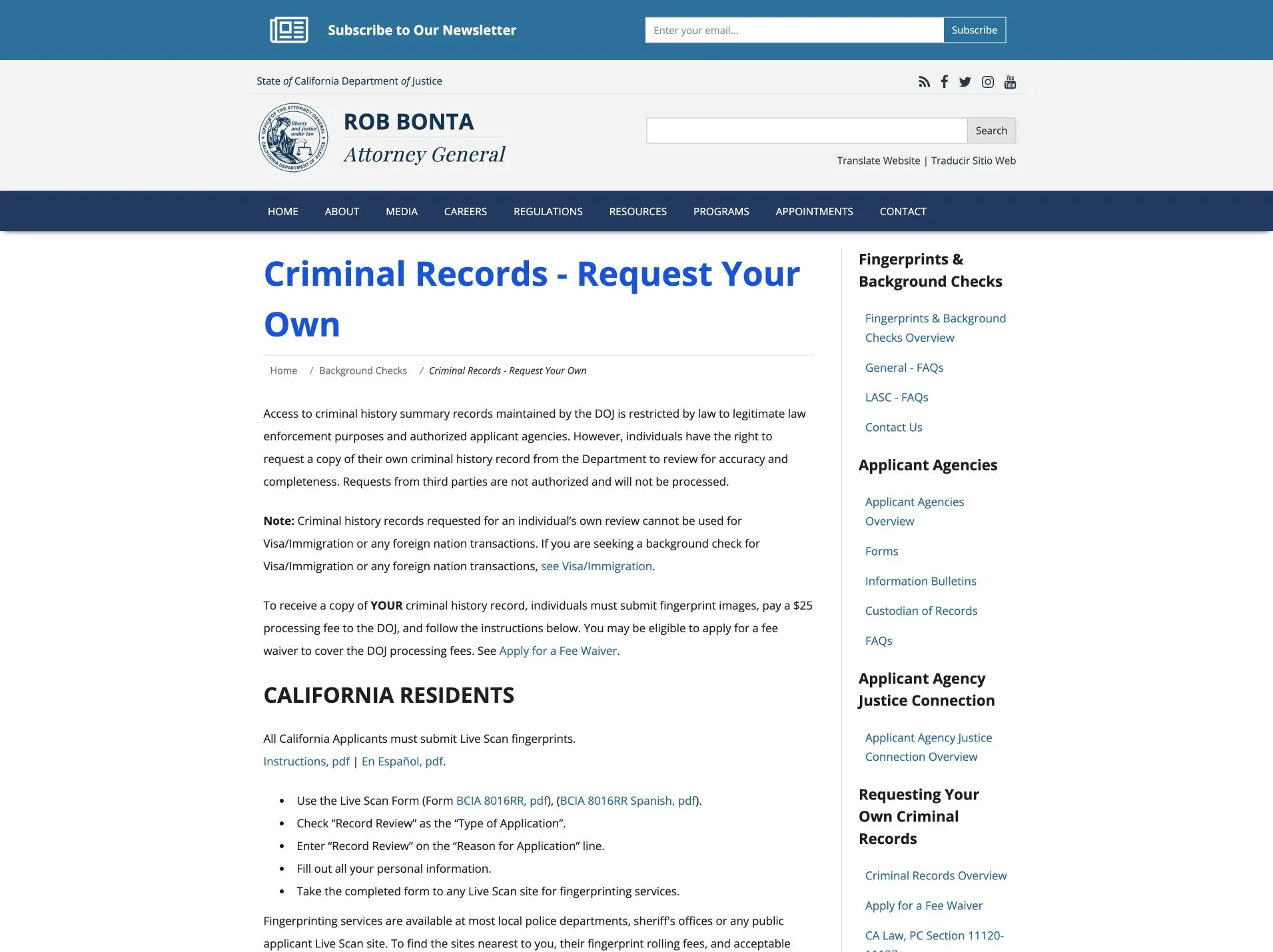
The California DOJ Record Review page states that individuals may request their own criminal-history record to review it for completeness and errors. Requests from third parties are not authorized. California residents submit fingerprints through Live Scan, use Form BCIA 8016RR, and pay the $25 DOJ processing fee unless a fee waiver applies. A Live Scan operator may charge a separate rolling fee.
What the Record Review process was like
I downloaded Form BCIA 8016RR from the DOJ website, selected “Record Review,” entered the same phrase as the reason for the application, and completed the personal-information fields. I then used the DOJ location list to choose a private Live Scan provider. The provider charged a rolling fee of roughly $30 to $35 in addition to the $25 DOJ fee.
At the appointment I presented the form and identification, had my fingerprints submitted electronically, and kept the receipt containing the ATI number. I later checked the Applicant Background Check Status page using that ATI number and my date of birth. The response arrived by mail. The process was bureaucratic but straightforward, and the DOJ materials repeatedly made clear that Record Review is for checking your own history.
Finding a Live Scan provider
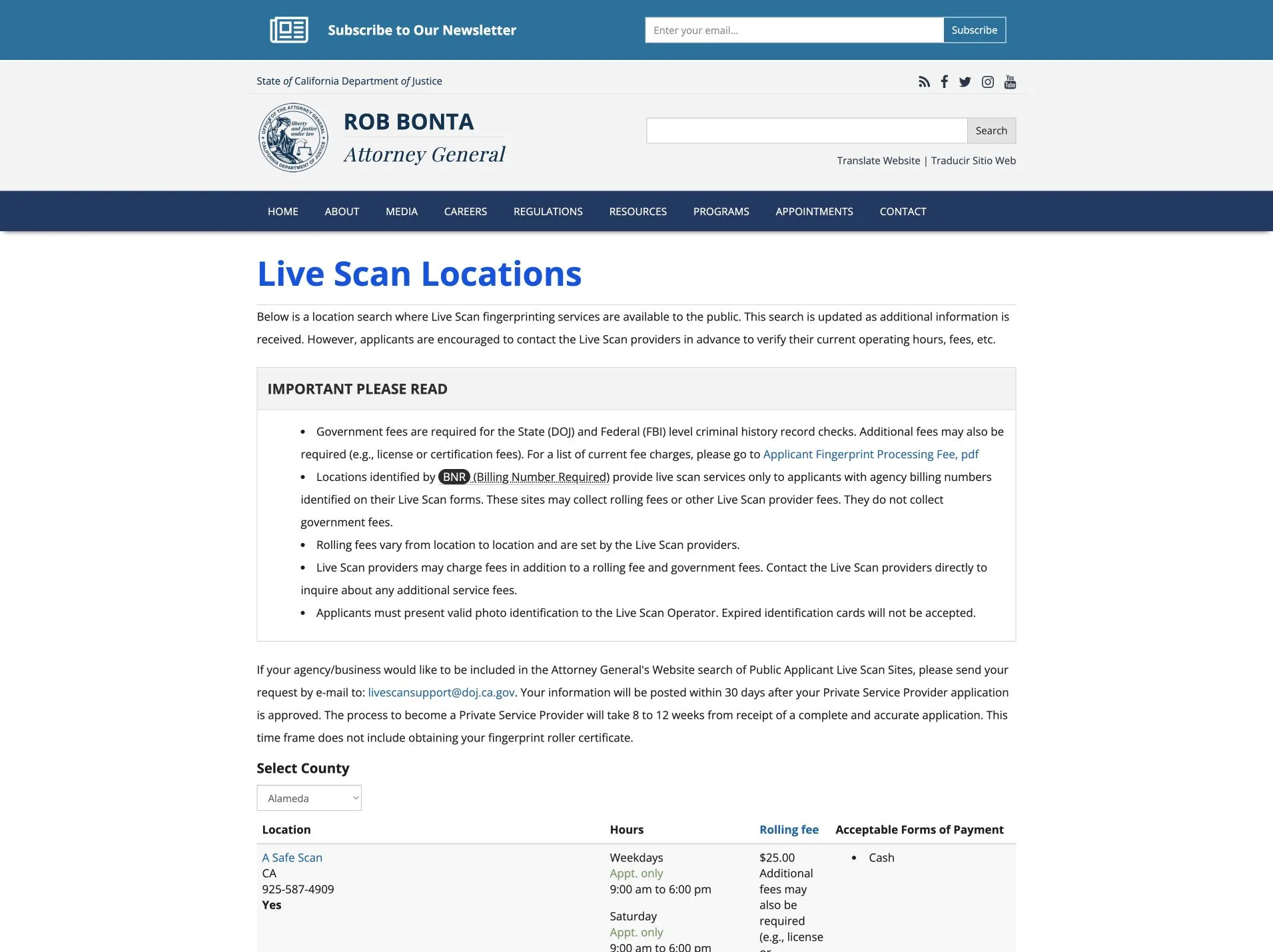
The DOJ's Public Live Scan Locations page lists providers by county along with reported hours, rolling fees, and accepted payment methods. The DOJ advises applicants to contact a provider before visiting because hours and fees may change.
Searching California Superior Court criminal cases
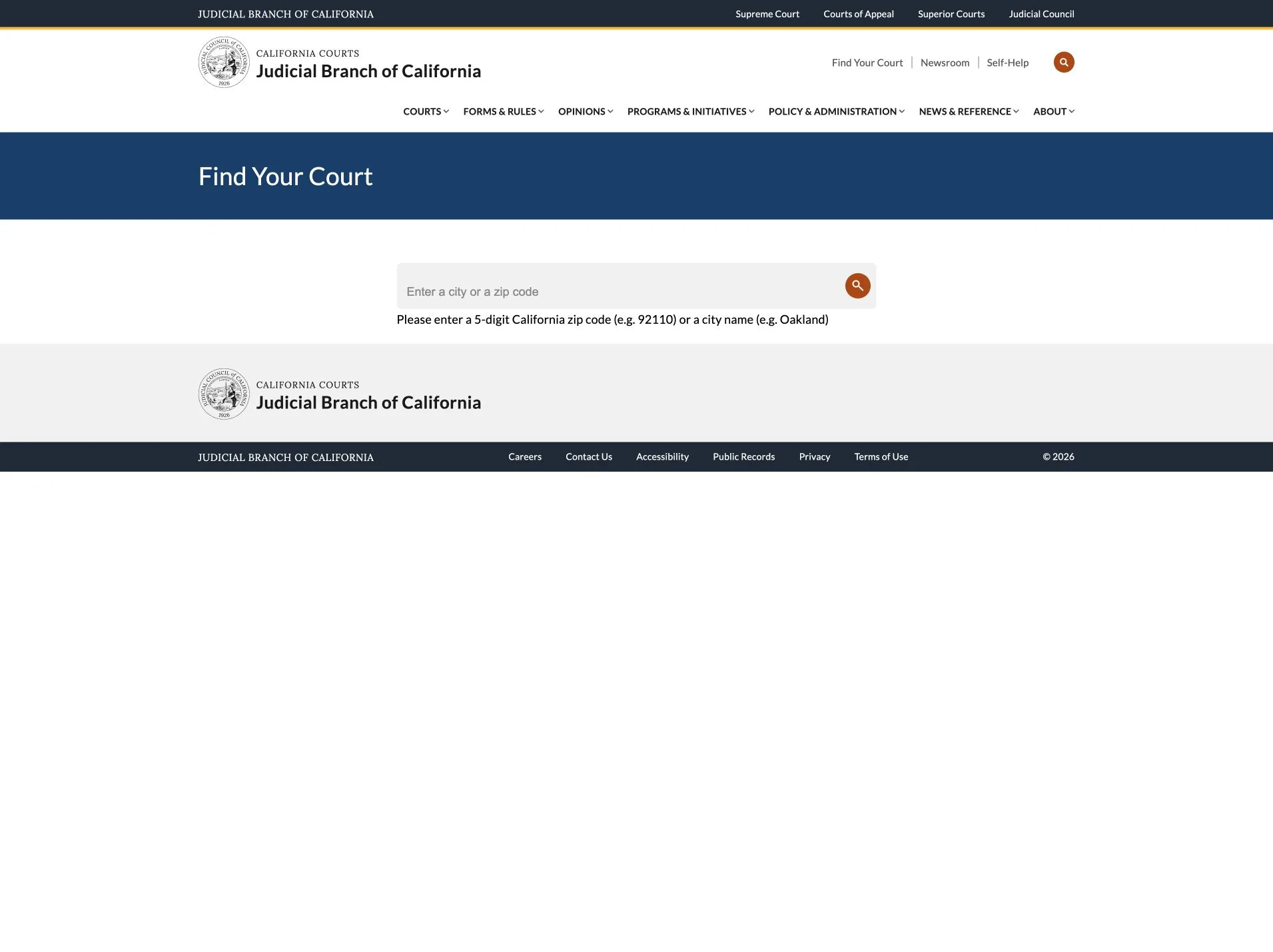
California has 58 Superior Courts, one for each county. The Judicial Branch explains that case information is maintained by the court where the case was filed. Some courts publish online indexes, some charge for name searches, and some records require a courthouse or clerk request. The statewide Find Your Court tool helps route a city or ZIP code to the appropriate court.
Under California Rule of Court 2.503, remote electronic access is more limited for certain records, including criminal case records. A courthouse may provide access that is not available on its public website. Sealed, confidential, juvenile, and other restricted records are not open merely because a name is known.
Example: using the San Diego Superior Court index
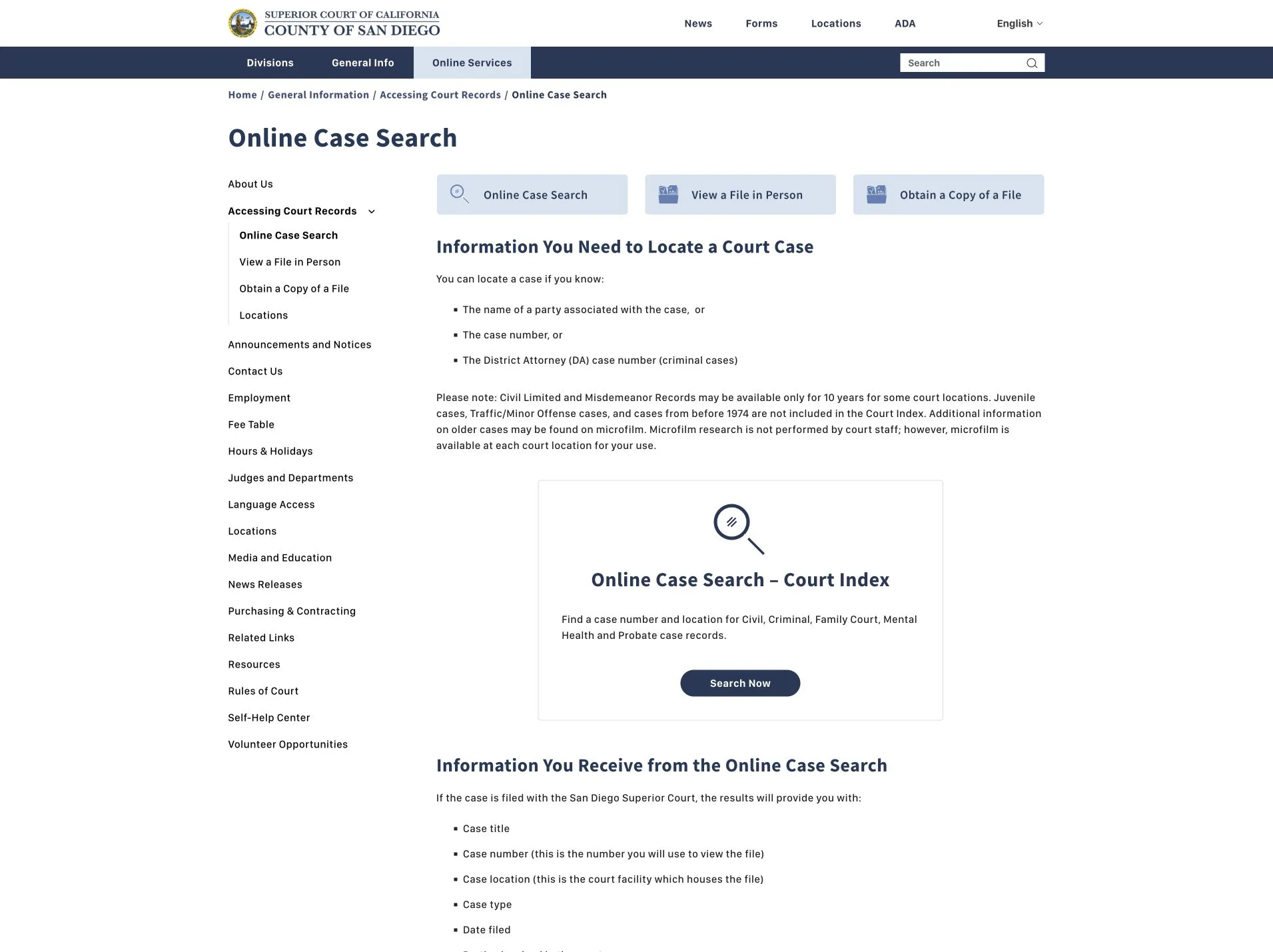
In my San Diego test, I opened the court's Online Case Search and searched with a first and last name. Multiple matches made a middle initial and approximate filing year useful. The index returned case numbers, filing dates, case types, court locations, and party names. It did not function as a complete criminal-history report.
The court explains that criminal case documents generally must be viewed at the courthouse where the matter was heard or requested by mail. It also identifies exclusions and coverage limitations, including juvenile cases, traffic or minor-offense cases, and cases from before 1974.
Example: Los Angeles Superior Court criminal case access
Los Angeles Superior Court offers a paid defendant-name search through its online services. When I used the public-access system, the results helped identify matching case numbers, filing dates, and courthouse locations. A case-number lookup could then provide a limited summary, such as the filing location, listed charges, and scheduled hearings when those fields were available.
The court states that criminal document images are not available online and that a name-search fee applies whether or not the desired case is found. Sealed information and older material may require a different court channel. This makes the service useful for locating a case, but it should not be described as a complete statewide criminal-history search.
Checking state-prison custody through CDCR CIRIS
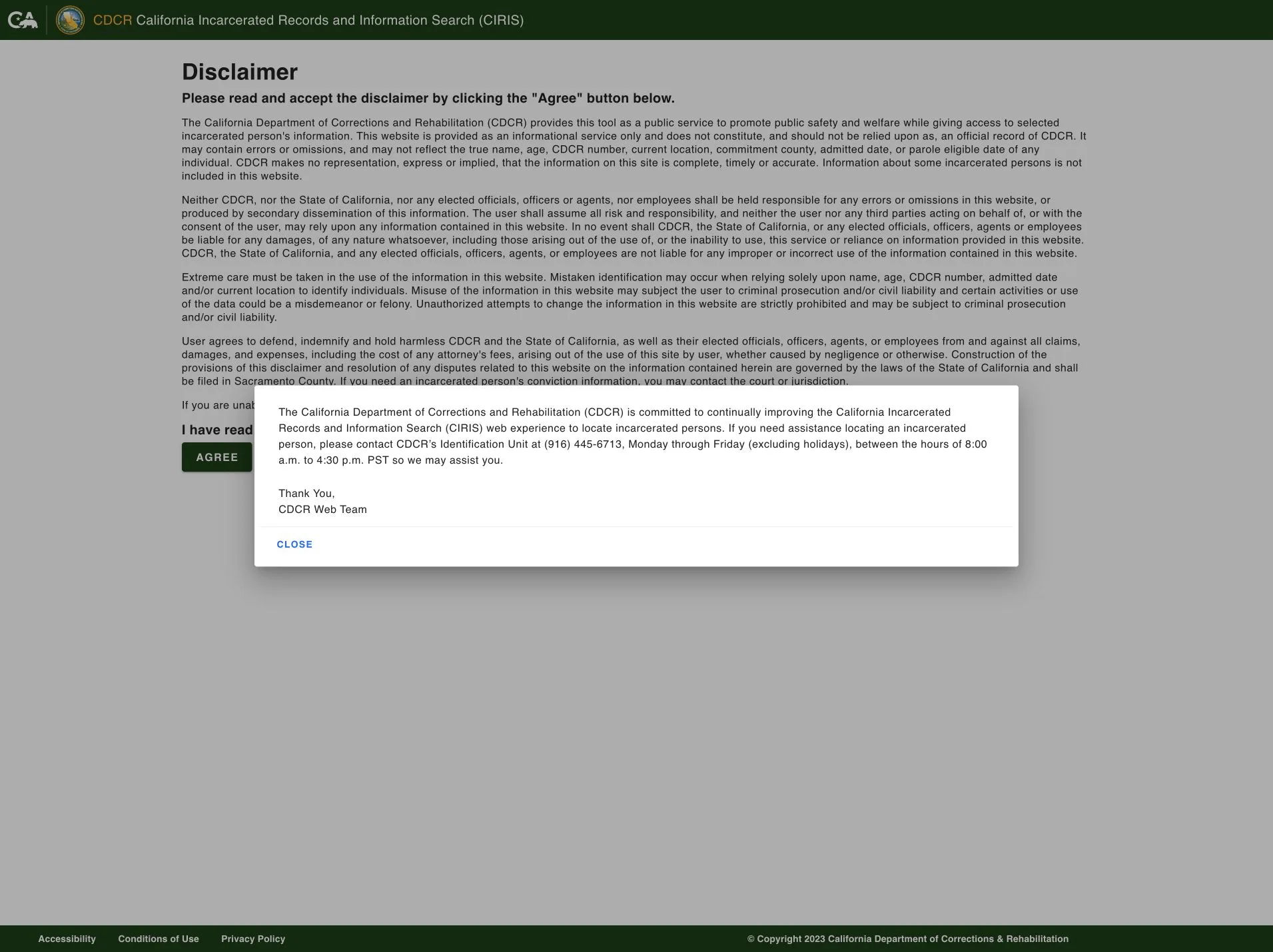
The California Incarcerated Records and Information Search provides selected information about people in CDCR custody. It is not a statewide criminal-history report and does not replace the court of conviction. CIRIS warns that its information can contain errors or omissions and may not reflect every current change.
What I found while testing CIRIS
I accepted the CIRIS disclaimer and searched by full name. When several possible matches appeared, a known CDCR number narrowed the result. The available fields included age, current facility, commitment county, admission date, and parole-hearing information when applicable. The underlying conviction detail was not presented, and CIRIS directed users to the original court for that information.
CIRIS worked well for the narrow question it is designed to answer: selected state-prison custody information. It should not be used to conclude that a person has no criminal case or county-jail record.
Searching California's Megan's Law registry
The official California Megan's Law website publishes information about specified registered sex offenders under Penal Code section 290.46. According to the state's Megan's Law summary, the information comes from California's Sex and Arson Registry. The website supports name and map-based searches and is separate from DOJ Record Review, Superior Court indexes, and CIRIS.
A missing public result does not establish that no registration record exists. California's daily registry statistics distinguish registrants whose full addresses are displayed, those shown by ZIP code, those who are not posted, and those omitted under approved exclusions. The site also notes that its community totals do not include people who are incarcerated or who have been deported.
Important use restriction
California restricts how Megan's Law information may be used. The state's official misuse guidance says the information is authorized for protecting a person at risk and identifies prohibited uses involving employment, housing, credit, insurance, education, and services. Review those restrictions before acting on a result.
California access, sealing, and record-relief rules
California criminal records do not all follow the same disclosure rule. The DOJ's fingerprint and criminal-history FAQ says state and local summary criminal history is confidential and is not subject to disclosure under the California Public Records Act. An individual may use Record Review to request their own history, while public court records are governed by separate court-access rules.
California Rule of Court 2.503 requires courts to make public electronic records reasonably available in some form, except for records that are sealed, confidential, or otherwise restricted. Remote access to records in criminal proceedings is generally more limited than courthouse access, although courts may make indexes, calendars, registers of actions, and other permitted information available online.
Record relief does not always mean that every trace of a case is destroyed. The California Courts' Clean Your Record guide explains that California does not offer a true expungement that erases a record. Available relief depends on the case. The DOJ likewise explains that a sealing order may leave information in its database for specified criminal-justice disclosures. A dismissal, sealing order, and deletion are different outcomes, so verify the current case status with the court or agency that maintains it.
What a California criminal-record search may not show
- A DOJ search for another person: the public Record Review process is limited to the requesting individual's own history.
- Every county in one court portal: each Superior Court maintains its own access system.
- Sealed or confidential information: restricted material does not become public through a name search.
- The final disposition from an arrest entry: an arrest does not establish that charges were filed or that a conviction occurred.
- County-jail custody in CIRIS: CIRIS covers CDCR information, not California's separate county-jail systems.
- Older cases online: historical coverage varies and may require the clerk, archives, microfilm, or an in-person visit.
A practical search order
- Write down the full name, middle initial, approximate age, city, and likely filing year.
- Use the California court finder if the city is known but the county is not.
- Check the county court's access instructions before paying or submitting identifying information.
- Use CIRIS only when state-prison custody is relevant. Use a county sheriff for current county-jail custody.
- Verify a matching result with the maintaining agency and final disposition before drawing a conclusion.
If you have only a name and do not know the county, a commercial people-search provider may help identify address or relative clues. PublicRecordsService.org does not produce the resulting report, and any provider shown after our form is independent from this site and from the State of California.
California criminal records by county and major city
California trial-court records are organized by county, so the county is usually more important than the city when choosing a court portal. Start with one of these county guides for the local court, sheriff, and city-specific context:
- Los Angeles County, including Los Angeles
- San Diego County, including San Diego
- Orange County, including Anaheim, Irvine, and Santa Ana
A county guide can help with location and identity clues, but the court, sheriff, DOJ, or CDCR remains the source for verifying a criminal case or custody record.
Frequently asked questions
Can I look up someone else's full California criminal history through the DOJ?
No. The California DOJ says individuals may request a copy of their own criminal-history summary for review, while third-party requests are not authorized. Public court information follows separate county Superior Court access rules.
Does California have one statewide public criminal court search?
No. California has 58 Superior Courts, and each court controls access to its case records. The California Courts website can help identify the correct county court but does not search every trial-court case statewide.
How much does a California DOJ Record Review cost?
The DOJ processing fee is $25 unless a fee waiver applies. A Live Scan provider may charge a separate rolling fee, so confirm the provider's current amount before the appointment.
Does CIRIS show California criminal convictions?
CIRIS presents selected CDCR custody information. It does not serve as a complete conviction report, and CDCR directs users to the court or jurisdiction for conviction information.
Is the California Megan's Law registry a complete criminal-history search?
No. It is a specialized public registry for information about specified registered sex offenders. It does not replace a county court search, a person's own DOJ Record Review, or a CDCR custody lookup.
Does expungement erase a California criminal record?
Not necessarily. California Courts explains that the state does not offer a true expungement that erases the record. Dismissal, sealing, and other forms of relief have different effects, and some information may remain available for specified purposes.
Can I use a people-search report for employment or tenant screening?
No. The commercial provider presented through this page is not a consumer reporting agency, and its reports must not be used for employment, tenant screening, credit, insurance, or another FCRA-regulated decision.