San Diego County covers 4,200 square miles from the Pacific coast to the inland desert and from the Mexican border north to Orange and Riverside counties. With an estimated 3.3 million residents, it is the second most populous county in California. Two features make San Diego County searches distinctly different from most large California counties. First, the military presence is substantial: Camp Pendleton (Marine Corps), MCAS Miramar, Naval Base San Diego (32nd Street), NAS North Island, and several other installations mean that a significant share of the county's population is active-duty military or recently separated — creating address volatility among the highest of any major California county. Second, the US-Mexico border at the county's southern edge produces cross-border record dynamics for residents with ties to Tijuana and Baja California.
Like all California counties, San Diego operates its own Superior Court independently — there is no unified statewide California court portal. San Diego Superior Court has multiple courthouse locations: the Central Courthouse in downtown San Diego, the East County Division in El Cajon, the North County Division in Vista, and the South Bay Courthouse in Chula Vista. For California's statewide framework, see our California state guide.
Key takeaways
- San Diego County has an estimated 3.3 million residents (U.S. Census Bureau, 2023 ACS) — California's second most populous county.
- Active-duty military at Camp Pendleton, Miramar, and Naval Base SD creates high address turnover — military personnel frequently have prior addresses across multiple states and rotate on 2-3 year PCS cycles.
- San Diego Superior Court has four main courthouse divisions: Central (downtown), North County (Vista), East County (El Cajon), and South Bay (Chula Vista). Geographic area of the relevant address or incident determines which division applies.
- El Cajon has one of the largest Iraqi and Chaldean communities in the United States — name searches there require Arabic and Chaldean name pattern awareness beyond standard Spanish-English variant checking.
San Diego County quick facts
- Population estimate (2023): approximately 3,298,000 (U.S. Census Bureau, 2023 ACS)
- County seat: San Diego
- Largest city: San Diego (est. pop. 1,387,000)
- State: California
- Primary court: San Diego County Superior Court (Central, North County, East County, and South Bay divisions)
Population estimates from the U.S. Census Bureau.
How to search San Diego County records
Identify the courthouse division before searching court records
San Diego Superior Court's online case access system allows name-based searches, but knowing the courthouse division associated with the subject's area improves result interpretation. The Central Courthouse in downtown San Diego handles major felonies, civil litigation, and family law for the city of San Diego and coastal communities. The North County Courthouse in Vista serves Oceanside, Escondido, Vista, Carlsbad, and inland North County. The East County Courthouse in El Cajon serves El Cajon, Santee, La Mesa, and the inland eastern communities. The South Bay Courthouse in Chula Vista serves National City, Chula Vista, and the border-area communities. The geographic area of the relevant incident or address — not the subject's residential address — typically determines which courthouse has jurisdiction for criminal matters. See our court record search guide for California's per-county Superior Court framework.
Treat San Diego addresses as potentially stale for military-connected subjects
Active-duty personnel rotate on PCS orders typically every two to three years. A San Diego address in any database may reflect a current posting or a posting from several years ago. For subjects identified as current or former military, prioritizing relative associations and a home-state check over address history produces more reliable results. The subject's home state of record — the state they listed when entering service — is where the current civilian address is most likely to be found after separation. For searches involving recently separated veterans, a prior-state aggregator search is often more productive than extended California address history checking. Our find someone by first and last name guide covers how to use relative associations when address history is unreliable.
Apply appropriate name variant strategies by area
San Diego's demographic diversity requires different name variant approaches by geography. For Chula Vista and National City, Spanish two-surname conventions apply — check both the paternal-surname-only form and the full two-surname form. For El Cajon's large Iraqi and Chaldean community, Arabic name patterns include Arabic article prefixes (Al-, El-), different transliteration standards for the same name, and patronymic naming conventions where the father's first name becomes the son's last name across generations. A name that appears as "Youkhana" in one document may appear as "Yohannes" or "Yohanna" in another. For border-area communities in South San Diego, the same Spanish two-surname awareness that applies in Chula Vista applies, with the additional consideration that some subjects have primary records in Mexican government databases rather than US databases.
Official record sources in San Diego County
| Record type | Agency | Online access | Notes |
|---|---|---|---|
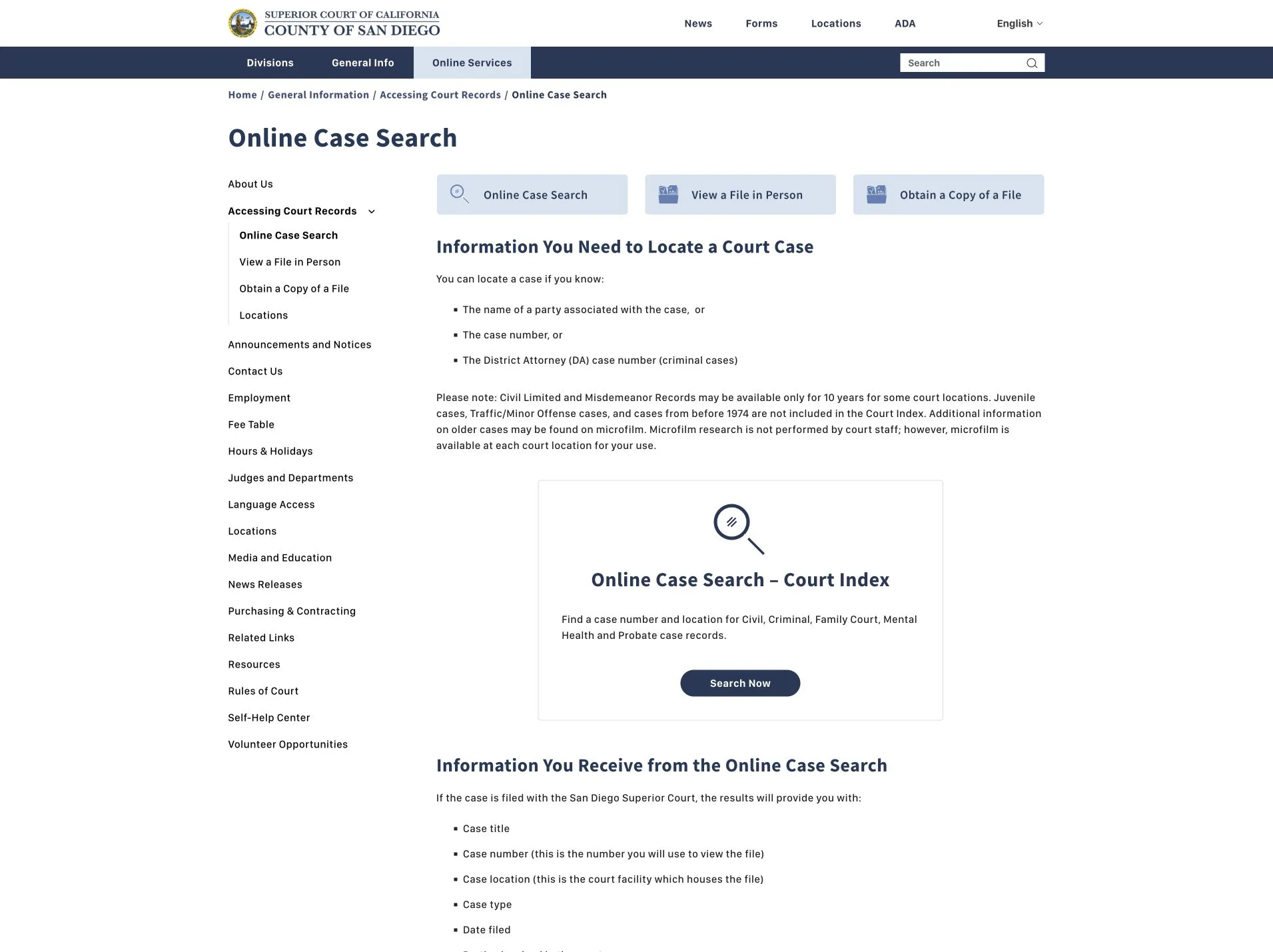
| Superior Court criminal and civil records | San Diego County Superior Court | sdcourt.ca.gov | Free name-based case search. Covers all courthouse divisions. Criminal and civil are separate query types. Coverage depth varies by division and record age. |
| Arrest and booking records | San Diego County Sheriff (SDSO) | sdsheriff.gov — inmate search | SDSO covers unincorporated county areas and contract cities and operates the county jail. San Diego PD maintains separate records for city of San Diego arrests. Other cities have their own departments. |
| Property records and deeds | San Diego County Assessor/Recorder/County Clerk | arcc.sdcounty.ca.gov | Combined office for property assessment, recorded documents, and vital records. Free name-based searches for ownership and assessed value. Recorded document index available online. |
| Marriage and death records | San Diego County Assessor/Recorder / CA CDPH | arcc.sdcounty.ca.gov and cdph.ca.gov | County Recorder holds local vital records. California CDPH maintains statewide index — marriage from 1960, death from 1905. Certified copies require fee and qualification. |
| Divorce records | San Diego County Superior Court (Family Division) | sdcourt.ca.gov | Divorce cases filed in Superior Court Family Division. Case index searchable online; full documents from the relevant courthouse clerk. |
For a broader overview of how public records are aggregated across jurisdictions, see our public record search guide.
Marriage records in San Diego County
Marriage licenses in San Diego County are issued by the San Diego County Assessor/Recorder/County Clerk, which operates as a combined office. The county recorder maintains a marriage index accessible through arcc.sdcounty.ca.gov. Certified copies require fee payment and proper qualification (spouse, parent, legal representative) and can be ordered online, by mail, or in person at the recorder's offices in San Diego, El Cajon, or Vista.
California Department of Public Health maintains a statewide marriage index from 1960 forward at cdph.ca.gov. For marriages before the online index, contact the County Recorder directly. San Diego County's military population generates a notable share of marriages involving out-of-state parties, so the subject's home state vital records may also be relevant for pre-California marriage records. For a full guide to how marriage record searches work across all states, see our marriage record search guide.
Divorce records in San Diego County
Divorce cases in California are filed in Superior Court in the county where either party resides. San Diego County Superior Court Family Division handles divorce filings for county residents. California requires at least six months of state residency and three months in the filing county before a divorce petition can be filed. Case indexes are searchable through the court's online system at sdcourt.ca.gov; full case documents require contact with the relevant courthouse clerk based on the geographic division.
California's Delete Act (SB 362, effective August 2026) will progressively thin commercial aggregator coverage for California residents. For San Diego County divorce records from prior to online indexing, the County Recorder and Superior Court clerk are the primary sources. For a full guide to how divorce record searches work across all states, see our divorce record search guide.
Industry insight
Military PCS moves make San Diego address history less reliable than in most large California counties. I have seen researchers spend significant time pursuing a San Diego address that was accurate three years ago for someone who has since PCS'd to Okinawa, Norfolk, or Fort Bragg. The tell is usually when the subject appears to have had multiple San Diego addresses in base-adjacent ZIP codes over a short period — that pattern suggests military-related moves within the area rather than civilian address changes. When I see that pattern, I immediately shift to checking relative associations and the subject's home state of record rather than continuing to pursue San Diego addresses.
The El Cajon situation is underappreciated by researchers outside California. It is not a small community — the Iraqi and Chaldean population in El Cajon is estimated at over 70,000, making it the largest Chaldean community in the Western Hemisphere. Searches involving El Cajon subjects and Arabic or Chaldean names require understanding that the same name may appear in very different transliterated forms across court records, commercial databases, and government records depending on who did the transcription and when. Running phonetic variants and consulting with the community-specific naming conventions before concluding no record exists is the standard approach here.
Common mistakes when searching in San Diego County
- Treating a San Diego address as current for a military-connected subject — active-duty personnel rotate on 2-3 year PCS cycles. A San Diego address may reflect a completed posting. Prioritize relative associations and home-state check over San Diego address history for military subjects.
- Using only one courthouse division's records for a subject who may have lived in multiple San Diego County areas — the Central, North County, East County, and South Bay divisions are separate. A search for someone who lived in Escondido and later moved to El Cajon may have records in both North County and East County courthouses.
- Not applying Arabic and Chaldean name variant awareness for El Cajon searches — the area has one of the largest Chaldean communities in the Western Hemisphere. Standard English-Spanish variant checking is insufficient; Arabic transliteration variants and patronymic naming patterns require separate consideration.
- Missing the California Delete Act timeline for future commercial searches — SB 362 creates a single opt-out mechanism effective August 2026. San Diego County residents who opt out will progressively disappear from commercial aggregator results. Court portal searches will become increasingly important for completeness.
Crime statistics and public-safety context
San Diego County's crime rates vary significantly by area. The city of San Diego reports moderate violent crime rates by California large-city standards. The eastern and southeastern communities near the border — National City, Chula Vista, and the San Ysidro area — have historically reported higher property crime rates. North County coastal communities report among the lower rates in the county. California DOJ statistics for 2023 showed San Diego County's overall rates below the Los Angeles County average but above the statewide average in some categories. Source: California Department of Justice, Crime in California 2023.
Major cities in San Diego County
San Diego
San Diego (est. pop. 1,387,000 — U.S. Census Bureau, 2023 ACS) is the county seat and the eighth-largest city in the United States. Naval Base San Diego on 32nd Street and MCAS Miramar both generate significant military address activity in city ZIP codes. The city's diverse neighborhoods — Mission Valley, Mission Hills, Barrio Logan, North Park, and dozens of others — produce records heard at different courthouse divisions depending on geographic area. SDPD is the primary law enforcement agency for city matters.
Chula Vista
Chula Vista (est. pop. 277,000 — U.S. Census Bureau, 2023 ACS) is the second-largest city in the county, between San Diego and the Mexican border. Chula Vista's proximity to the Otay Mesa border crossing and its large Mexican-American community means some residents have ties to Tijuana that produce cross-border address history elements. The South Bay Courthouse handles Chula Vista-area court matters. Spanish two-surname variant awareness is standard for Chula Vista searches.
Oceanside
Oceanside (est. pop. 176,000 — U.S. Census Bureau, 2023 ACS) is the largest North County city and borders Camp Pendleton. The Marine Corps base generates extremely high address turnover in Oceanside ZIP codes — a significant share of the city's population at any given time is Marines and their families on temporary assignment. Address records in Oceanside-area ZIP codes should be treated with higher volatility assumptions than civilian-only communities. North County Courthouse in Vista handles Oceanside matters.
El Cajon
El Cajon (est. pop. 101,000 — U.S. Census Bureau, 2023 ACS) anchors the East County and is home to an estimated 70,000 or more Iraqi and Chaldean residents — the largest Chaldean community in the Western Hemisphere. Arabic and Chaldean name patterns require phonetic variant checking and awareness of patronymic naming conventions for thorough searches. East County Courthouse handles El Cajon matters.
Escondido
Escondido (est. pop. 152,000 — U.S. Census Bureau, 2023 ACS) is an inland North County city that serves as a regional center for the inland communities east of Vista and Oceanside. Escondido's large Hispanic population benefits from Spanish surname variant awareness in name searches. The city has a more stable long-term resident character than the military-adjacent coastal communities, making address records relatively reliable here. North County Courthouse handles Escondido matters.
Common search scenarios
Searching by name and city in San Diego County
Establish the courthouse division first based on the subject's geographic area, then run the San Diego Superior Court online system. For military-connected subjects, supplement with a prior-state aggregator search. For Spanish surnames in Chula Vista and the South Bay, check two-surname variants. For Arabic and Chaldean names in El Cajon, check transliteration variants before concluding no record exists. See our guide on finding someone by name and city.
Checking San Diego County court records
San Diego Superior Court's online case access at sdcourt.ca.gov is the primary starting point. Criminal and civil cases are searchable by name across all courthouse divisions. For arrests, SDSO's online inmate search covers the county jail system; SDPD maintains separate records for city arrests. For older records or document access, contact the specific courthouse clerk. See our court record search guide.
Searching for recently relocated or separated military
San Diego is one of the largest military hubs in the United States. For recently separated veterans, the San Diego address is often the final military-era address rather than a current civilian one. Running a prior-state check based on the service member's home state of record is often more productive than assuming the San Diego address is current. A name and relative search that surfaces the home state is the fastest path to a current location for recently separated military.
Start Here: Enter Any Name To View Records
Best sites to review first
Before moving into San Diego Superior Court or SDSO records, these are the two services I recommend reviewing first — particularly useful for establishing current address when military-related address churn or cross-border dynamics are factors.
| Service | Why people use it | Best fit |
|---|---|---|
| Instant Checkmate | Aggregates address history and relative associations across California and other states — useful for surfacing prior-state addresses for recently relocated or separated military | Building current address anchors when San Diego military-era addresses may be stale |
| TruthFinder | Broader report-style context including multi-state address chain — useful for subjects with extensive military PCS history across multiple states | Multi-state address chain searches for military and recently separated veteran subjects |
Important: These services are not FCRA-compliant consumer reporting agencies. Do not use them for employment screening, tenant decisions, insurance underwriting, or any other purpose regulated by the Fair Credit Reporting Act.
Frequently asked questions
Why are San Diego addresses often unreliable for military-connected subjects?
Active-duty military personnel rotate on PCS orders typically every two to three years. A San Diego address in a database may reflect a current tour of duty or one that ended years ago. For recently separated veterans, the San Diego address is often the final military-era address rather than a current civilian one. Prioritizing relative associations and a home-state check over address history produces better results for military-connected San Diego subjects.
Which San Diego courthouse handles records for my search area?
San Diego Superior Court operates four main divisions: the Central Courthouse in downtown San Diego for the city of San Diego and coastal communities; the North County Courthouse in Vista for Oceanside through Escondido and inland North County; the East County Courthouse in El Cajon for the eastern inland communities; and the South Bay Courthouse in Chula Vista for National City, Chula Vista, and the border-area communities. The geographic area of the relevant incident or address determines which courthouse division typically applies.
How do name searches work in El Cajon's Chaldean community?
El Cajon has the largest Chaldean community in the Western Hemisphere, estimated at over 70,000 residents. Chaldean and Iraqi names follow Arabic naming conventions that include article prefixes (Al-, El-), different transliteration standards for the same sound, and patronymic patterns where the father's first name functions as the son's family name. The same individual may appear under significantly different name forms in court records, government databases, and commercial aggregators. Running phonetic variants alongside the expected spelling is the standard approach for El Cajon searches involving Arabic or Chaldean names.
Where do I find marriage and divorce records for San Diego County?
Marriage licenses are issued by the San Diego County Assessor/Recorder/County Clerk, with records and index searches at arcc.sdcounty.ca.gov. Certified copies require a fee and qualification. California CDPH maintains a statewide marriage index from 1960 forward. Divorce records are in San Diego County Superior Court Family Division, searchable through sdcourt.ca.gov. Full documents require contact with the relevant courthouse clerk.
How do I find property records for San Diego County?
The San Diego County Assessor/Recorder/County Clerk (arcc.sdcounty.ca.gov) is a combined office that handles property assessment, recorded documents including deeds and liens, and vital records. Property ownership and value data are searchable free online by owner name or address. Recorded documents are indexed online; certified copies require a fee.
Does California's Delete Act affect San Diego County searches?
Yes. California's SB 362 creates a single opt-out mechanism for data broker databases, effective August 2026. San Diego County residents who opt out will progressively disappear from commercial aggregator results. The county's substantial military population adds another layer — service members and their families often have limited commercial data footprints already. Court portal searches will become more important relative to commercial aggregators as SB 362 takes effect.
Can I use these searches for jobs, housing, or insurance decisions?
No. The services discussed on this page are not consumer reporting agencies and the information here is not a consumer report. They should not be used for employment, tenant screening, insurance underwriting, credit, or any other purpose regulated by the Fair Credit Reporting Act.